
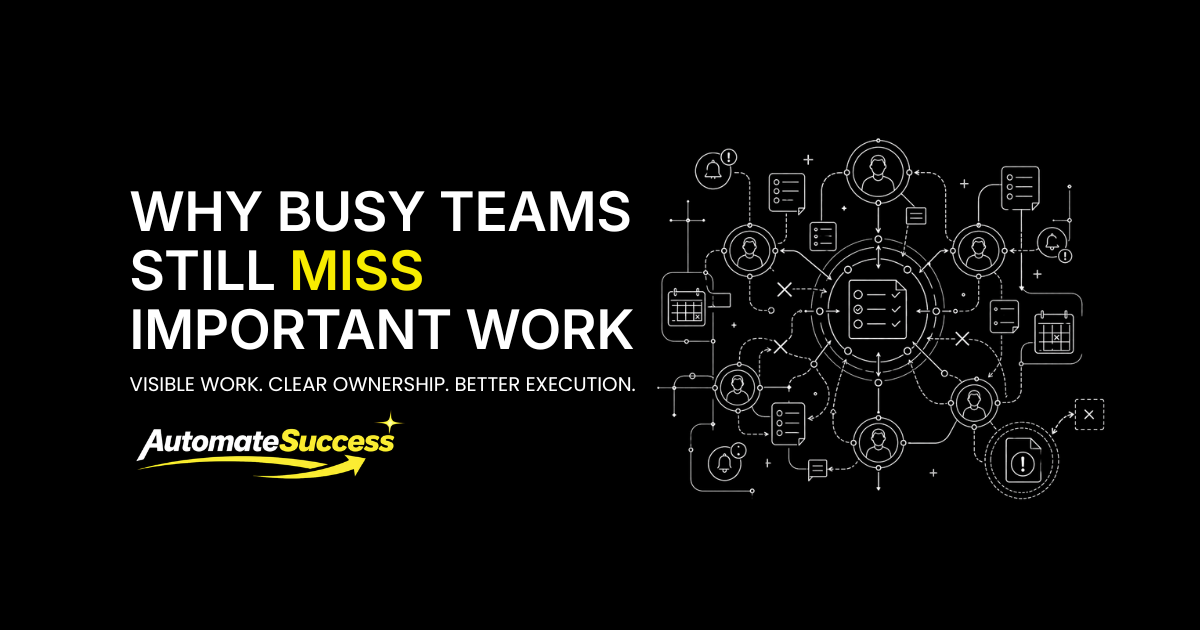
The problem with being busy
Most teams are not short of things to do. They are answering emails, joining meetings, updating systems, responding to customers, chasing information, solving problems and trying to keep daily work moving.
From the outside, the business can look active and productive. Everyone is busy. The problem is that busy does not always mean controlled.
Important work can still be missed. Deadlines can still slip. Customers can still be left waiting. Managers can still find themselves chasing updates that should already be clear.
This is one of the most frustrating problems inside a growing business. The team is working hard, but the business still feels reactive.
Activity is not the same as progress
A busy team can still be an unclear team. People may be doing work, but not always the right work. They may be responding quickly, but not necessarily to the most important tasks. They may be solving problems, but not addressing the reason those problems keep appearing.
This is where activity can become misleading. A full calendar does not mean priorities are clear. A long task list does not mean work is moving in the right order. A busy inbox does not mean customers are being managed properly.
When everything feels urgent, teams often default to whatever is loudest. That is how important work gets missed.
Missed work is often a visibility problem
Important work rarely disappears completely. More often, it becomes hidden.
It sits in an inbox. It lives in a private message. It is mentioned briefly in a meeting. It is added to someone’s mental list but never captured anywhere visible.
At that point, the business is relying on memory rather than a system. That might work when the team is small, but it becomes fragile as the business grows.
The more people involved, the easier it becomes for tasks, decisions and responsibilities to fall between gaps. Nobody is trying to ignore the work. The system simply has no reliable place for the work to live.
Ownership matters more than effort
When work is missed, the first assumption is often that somebody has failed. But many missed tasks are not caused by laziness or lack of effort.
They are caused by unclear ownership.
If nobody clearly owns a task, it becomes easy to assume someone else is dealing with it. If two people partly own it, both may wait for the other to move it forward. If ownership changes during a process, the handover can become the weak point.
This is how work falls through the cracks. Not because nobody cares. Because nobody is clearly accountable.
A task without an owner is not really a task. It is a risk.
Communication is not a system
Many businesses try to manage work through communication alone. They use emails, messages, meetings and verbal updates to keep things moving.
Communication is important, but it is not the same as a system.
A message can be missed. An email can be buried. A meeting can end without actions being recorded. A verbal update can be forgotten by the end of the day.
If the business relies on communication without structure, work becomes dependent on people remembering what was said, who said it and what needs to happen next. That creates unnecessary risk.
The better approach is to make communication support the system, not replace it.
The fix is clarity
Busy teams do not need more pressure. They need more clarity.
What needs to be done? Who owns it? When is it due? What happens if it gets stuck? Where should progress be recorded? Who needs to be updated?
These questions sound basic, but they are often where growing businesses struggle.
When answers are unclear, managers become the system. They chase. They remind. They follow up. They remember what others forget.
That may keep the business moving for a while, but it does not scale. Eventually, the manager becomes the bottleneck.
Better systems reduce missed work
The solution is not to remove all flexibility from the business. The solution is to make important work visible.
That might mean a better project management system, clearer task ownership, a stronger issue escalation process, improved workload visibility or a more consistent meeting framework.
The exact tool matters less than the principle.
Important work should not rely on memory. It should have a visible place to live, a clear owner and a defined next action.
When that happens, the business becomes less reactive. Managers spend less time chasing. Teams spend less time guessing. Customers get a more consistent experience. And important work is far less likely to disappear.
Automate Success Observation
Most teams do not miss important work because they are not busy enough.
They miss it because the work is not visible, owned or prioritised clearly.
Busy teams need better systems, not more pressure.