
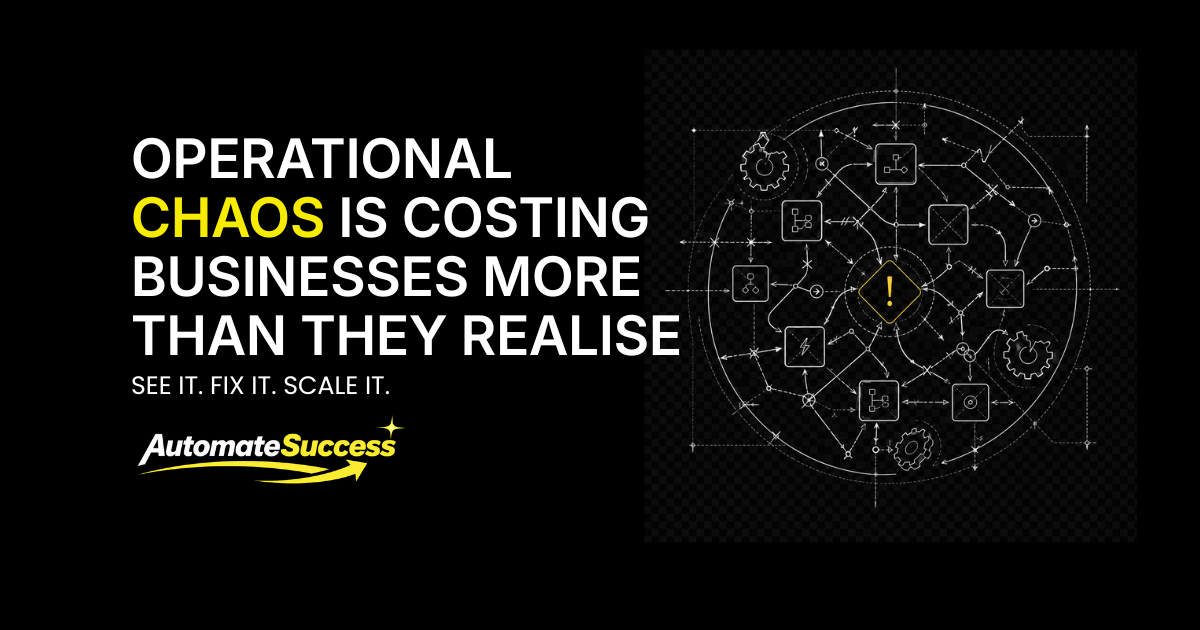
The Hidden Cost of Business Friction
From the outside, many businesses appear to be thriving.
Revenue is growing. New products are being launched. Teams are expanding. New initiatives are constantly being introduced.
Everything looks positive.
But beneath the surface, it’s a different story.
Like a duck gliding across a pond, the business appears calm from a distance. Under the water, however, its legs are paddling furiously just to stay afloat.
Processes are being held together by spreadsheets. Employees are creating workarounds. Managers are chasing updates. Information is scattered across multiple systems.
The business is moving forward, but it is consuming far more energy than it should.
The problem isn’t growth.
The problem is operational chaos.
Why Chaos Develops Gradually
Operational chaos rarely comes from one major issue.
Instead, it develops gradually through dozens of small inefficiencies.
Common examples include:
- Poor communication
- Multiple disconnected systems
- Outdated or undocumented processes
- Lack of visibility across teams
- Constant firefighting
- Departments working towards different objectives
Individually, these problems may seem manageable.
Together, they create friction throughout the organisation.
Tasks take longer than necessary. Decisions are delayed. Employees become frustrated. Opportunities are missed.
Over time, the cost becomes significant.
Can AI Solve Operational Chaos?
Many of these issues can be improved through automation and AI.
However, technology alone is rarely the answer.
A business that lacks clarity, structure and alignment will often automate chaos rather than eliminate it.
The most successful implementations start with understanding the problem first.
Only then should organisations explore how automation, AI and technology can support the solution.
When implemented as part of a wider strategy, AI can:
- Reduce operational friction
- Improve visibility
- Increase consistency
- Eliminate repetitive tasks
- Create more capacity for higher-value work
The key is to view AI as part of a system, not as a standalone fix.
Chaos Is a Systems Problem
Chaos is rarely a people problem.
More often, it is a systems problem.
Businesses don’t become chaotic overnight. They become chaotic through years of disconnected decisions, duplicated processes and poorly designed workflows.
The good news is that systems can be improved.
Before investing in another tool, another platform or another piece of technology, take a step back and ask a simple question:
Where is the friction coming from?
The answer is often the starting point for meaningful improvement.
AUTOMATE SUCCESS FRAMEWORK
What is Operational Chaos?
Operational chaos occurs when disconnected systems, poor communication, inefficient processes and poor visibility create friction throughout a business.
Key Insight: Operational chaos is rarely caused by one major problem. It develops through dozens of small inefficiencies that compound over time.